
 Hauptwebsite

Are backhoe and excavator the same?
If you are comparing construction equipment, you may wonder: Are backhoe and excavator the same? The short answer is no. Although both machines can dig, a Backhoe Loader and an Excavator are designed for different purposes.
A Backhoe Loader combines a front loader bucket with a rear digging arm, making it a versatile choice for digging, loading, backfilling, and general construction work. An Excavator is primarily designed for excavation, offering greater digging capability, reach, and stability for many demanding earthmoving applications.
So, which machine is right for your project? This guide explains the key differences between a Backhoe vs Excavator, including their design, digging performance, mobility, typical applications, and specifications, so you can understand where each machine fits best.
1. Quick Answer: Are Backhoe and Excavator the Same?
No. A backhoe loader and an excavator are different types of construction equipment. Although both machines can dig, a backhoe loader is designed as a versatile machine that combines digging and front-end loading, while an excavator is primarily built for excavation.
A backhoe loader is generally suited to projects that require multiple tasks and mobility, while an excavator is more focused on excavation performance, digging reach, depth, and stability.
The key difference is not simply that both machines can dig, but how they are designed and what type of work they are optimized to perform.
2. Key Takeaways: Backhoe vs Excavator
- Backhoe loaders prioritize versatility and mobility. By combining digging and front-end loading capabilities, they can handle multiple common construction tasks with one machine.
- Excavators prioritize excavation performance. Their key strengths include digging depth, working reach, digging force, and stability, making them well suited to excavation-intensive work.
- Backhoe loaders and excavators are not simply interchangeable. Although both can perform digging tasks, their different designs and capabilities make them suitable for different operating requirements.
- Equipment selection should be based on the actual job. The type of work, required digging performance, working conditions, mobility needs, and range of tasks should all be considered when choosing between a backhoe loader and an excavator.
In short, a backhoe loader is built around versatility and mobility, while an excavator is built primarily around excavation performance.
3. What Is a Backhoe Loader?
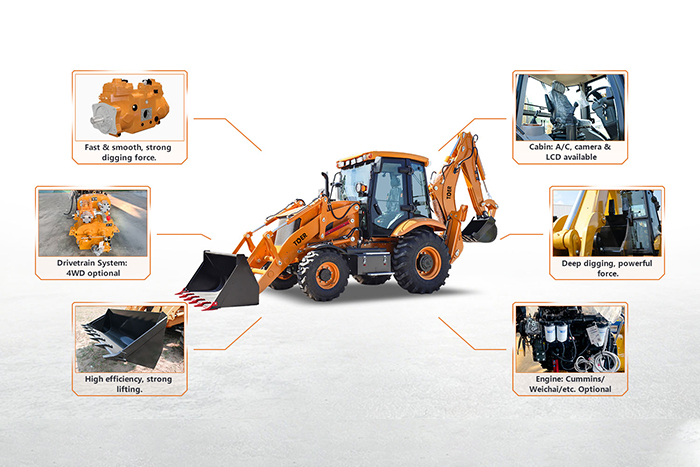
A Backhoe Loader is a versatile construction machine that combines a front loader with a rear-mounted backhoe on a wheeled chassis. This configuration allows one machine to perform both material-handling and excavation-related tasks. The combination of a front bucket and rear digging arm is the defining feature of a backhoe loader.
Basic Structure of a Backhoe Loader
A typical backhoe loader consists of several key components:
- Front loader: The front bucket is used for loading, carrying, grading, and moving materials such as soil, sand, gravel, and construction debris.
- Rear backhoe: The rear digging assembly uses a boom, dipper arm, and bucket for excavation, trenching, and backfilling.
- Wheeled chassis: The wheel-based chassis provides mobility between work areas and supports the machine's multi-purpose design.
- Stabilizer legs: Stabilizers provide support when the rear backhoe is operating. TDER offers both A-type and H-type stabilizer leg options, allowing customers to choose the configuration that best suits their machine and application requirements.
What Is a Backhoe Loader Used For?
A Backhoe Loader is commonly used for trenching, utility installation, backfilling, site preparation, road maintenance, material loading, and general earthmoving. It is particularly practical when excavation and material handling are both required within the same project.
Why Is a Backhoe Loader Considered Versatile?
Its versatility comes primarily from its dual-function configuration: the rear backhoe handles excavation, while the front loader handles loading and material movement. Compatible attachments can further extend its capabilities to tasks such as breaking, grading, lifting, and cleanup.
4. What Is an Excavator?
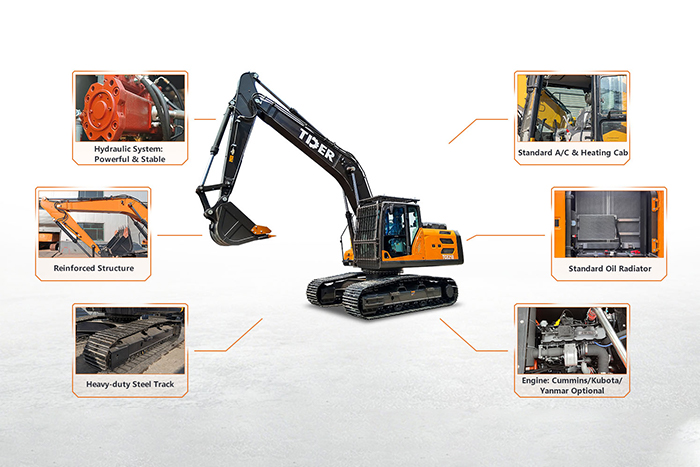
An Excavator is a construction machine primarily designed for excavation and earthmoving. Its working equipment is centered on a boom, arm, and bucket, which work together to dig, lift, and move material. Excavators are available in different configurations, including crawler and wheeled models, to suit different job-site conditions.
Basic Structure of an Excavator
A typical hydraulic excavator consists of several key components:
- Boom: Connects the upper structure to the digging equipment and positions the working attachment.
- Arm (stick): Extends the working range and works with the boom and bucket during excavation.
- Bucket: Penetrates, collects, and moves soil, rock, gravel, and other materials. Different bucket types can be selected for specific applications.
- Upper structure: Houses the operator's cab, engine, hydraulic system, and other major components and rotates relative to the undercarriage.
- Undercarriage: Supports the machine and provides mobility. Excavators can use tracks or wheels depending on the model and application.
Together, these components form the excavator's primary working system, with the boom, arm, and bucket providing the main digging function.
What Is an Excavator Used For?
Excavators are commonly used for trenching, foundation excavation, earthmoving, site preparation, drainage work, demolition, and material handling. Different attachments can also be installed for specialized applications, allowing the same basic machine to perform tasks beyond standard bucket excavation.
Compared with machines designed around multiple primary functions, an excavator is generally selected when excavation is a major part of the project. Its dedicated working equipment makes it suitable for projects that require consistent digging and material-handling operations.
5. Backhoe vs Excavator: Key Differences and Which Jobs They Fit
Backhoe Loaders and Excavators can both perform excavation work, but their different designs give them different capabilities and operating characteristics. The following comparison looks at their machine design, rotation, digging performance, stability, mobility, material handling, attachments, and typical applications.
How Do Their Designs Differ?
The most fundamental difference between a Backhoe Loader and an Excavator is their overall machine architecture.
A Backhoe Loader combines two working systems in one wheeled machine. The front loader bucket is used for loading, carrying, grading, and material movement, while the rear boom, arm, and bucket handle excavation and trenching. The rear digging assembly can also be configured in different ways. For example, TDER can provide John Deere-style excavator arm designs for selected configurations to meet different working requirements.
An Excavator, by comparison, is built primarily around a dedicated boom, arm, and bucket system mounted on a rotating upper structure. This architecture allows the working equipment to be positioned around the machine while the undercarriage remains relatively stationary.
In simple terms, a Backhoe Loader is designed around multi-function operation, while an Excavator is designed around dedicated excavation performance. This basic difference influences their rotation, digging capability, mobility, and material-handling characteristics.
How Does Their Rotation Capability Differ?
An Excavator can rotate its upper structure around the undercarriage, allowing the operator to change the working direction without repositioning the entire machine. This provides a broad working range around the machine and is particularly useful for excavation in different directions.
A Backhoe Loader's rear digging equipment operates within a defined swing range rather than rotating the entire upper structure. However, its working configuration can be adapted to improve positioning flexibility. TDER offers H-type stabilizer configurations that support side-shift digging, allowing the rear working equipment to move laterally when working alongside roads, walls, or other obstacles.
The key difference is therefore not simply the amount of rotation, but how each machine positions its digging equipment within the work area.
Which Has Greater Digging Depth, Reach, and Force?
When comparing digging depth, working reach, and digging force, Excavators generally have an advantage because their entire machine architecture is centered on excavation. The boom, arm, bucket, hydraulic system, and rotating upper structure work together to provide a wide working envelope and consistent digging performance.
However, this does not mean that every Excavator will outperform every Backhoe Loader. Machine size, hydraulic system, boom and arm design, bucket configuration, and operating weight can all affect actual performance. Some Backhoe Loaders can also be equipped with specialized configurations, such as telescopic excavation equipment, to extend their working range.
For buyers, the most useful comparison is therefore based on actual specifications rather than machine type alone. Key figures include maximum digging depth, maximum excavation radius, digging force, bucket capacity, and lifting height. These specifications should be matched to the required trench depth, excavation distance, material type, and working area.
How Do Stability and Lifting Capability Differ?
Stability is important when a machine is digging, lifting, or working with a loaded attachment. The overall result depends on machine weight, undercarriage design, center of gravity, working radius, ground conditions, and machine configuration.
An Excavator typically uses its undercarriage, counterweight, and rotating upper structure as part of its stability system. A Backhoe Loader, meanwhile, relies on its wheeled chassis and stabilizer legs when the rear digging equipment is in operation. The stabilizers increase ground support and help keep the machine stable while digging.
Stabilizer configuration can also influence how the machine performs in different working environments. TDER offers both A-type and H-type stabilizer leg options, allowing the configuration to be selected according to the intended working conditions and application requirements.
For lifting, buyers should not look only at the rated lifting capacity. Load radius, lifting height, attachment weight, ground conditions, and machine configuration can all affect the practical lifting capability of the equipment.
How Do Mobility and Transportation Differ?
Mobility is one of the most noticeable differences between Backhoe Loaders and Excavators. A wheeled Backhoe Loader is designed to travel efficiently between work areas, making it practical for construction, road maintenance, utility, and municipal projects where the machine may need to move frequently.
Excavators are available in both tracked and wheeled configurations. Tracked Excavators provide good traction and stability on many uneven job sites, but they are generally transported between distant locations rather than driven long distances on public roads. Wheeled Excavators can offer greater road mobility and are often selected when frequent movement between work areas is required.
Backhoe Loader maneuverability can also vary by steering configuration. TDER offers selected configurations with four-wheel drive, four-wheel steering, multi-mode steering, and crab-walking capability, helping the machine maneuver in narrow, irregular, or changing work areas.
Therefore, mobility should be evaluated based on travel frequency, terrain, road conditions, job-site layout, and transportation requirements, rather than simply comparing wheels with tracks.
Which Has Better Loading and Material-Handling Capability?
One of the clearest functional differences between a Backhoe Loader and an Excavator is their approach to material handling.
A Backhoe Loader has a front loader bucket in addition to its rear digging equipment. This allows the machine to load, carry, spread, level, and move materials such as soil, sand, gravel, and construction debris without changing to a different machine. For projects that combine excavation with frequent loading or site cleanup, this dual-purpose configuration can reduce the need to switch between machines.
An Excavator can also handle materials with its bucket and other attachments, particularly when loading or moving material within its working range. However, it does not normally have the same front-loader configuration as a Backhoe Loader.
Therefore, when a project requires both excavation and regular front-end loading, a Backhoe Loader can provide greater functional flexibility. When excavation is the primary task and material handling is mainly performed within the excavator's working envelope, an Excavator may be more appropriate.
How Do Their Attachments and Versatility Differ?
Both Backhoe Loaders and Excavators can use different attachments, but the available configurations and the way those attachments are used can differ by machine.
Backhoe Loaders can combine attachments on both the front loader side and rear excavator side. Depending on the machine and hydraulic configuration, options may include buckets, forks, hydraulic breakers, sweepers, compactors, augers, and other specialized tools. This allows one machine to perform several types of work without being limited to standard digging and loading.
Excavators also support a broad range of attachments, including different digging buckets, hydraulic hammers, augers, grapples, thumbs, mulchers, and other specialized equipment. Attachment selection can significantly expand an excavator's application range beyond conventional excavation.
The important distinction is therefore not simply which machine accepts more attachments, but how the attachment system supports the project's workflow. A Backhoe Loader offers versatility across its front and rear working ends, while an Excavator provides a dedicated platform for excavation-focused attachments and specialized hydraulic tools.
Which Machine Fits Different Jobs?
The choice between a Backhoe Loader and an Excavator depends on the type of work, required excavation performance, and how many different tasks the machine needs to perform.
A Backhoe Loader is generally suitable for projects that combine digging, loading, backfilling, grading, and frequent movement. An Excavator is generally more appropriate when excavation is the primary task and the project requires greater working reach, digging capability, stability, or specialized attachments.
|
Application |
Backhoe Loader |
Excavator |
|
Utility trenching |
Suitable for general and mobile projects |
Suitable for deeper or excavation-focused work |
|
Road maintenance |
Highly versatile for digging, loading, and backfilling |
Suitable for excavation-intensive roadwork |
|
General construction |
Suitable for multi-function operations |
Suitable when excavation is a major task |
|
Site preparation |
Suitable for light-to-medium earthmoving |
Suitable for larger-scale excavation and earthmoving |
|
Foundation excavation |
Suitable for smaller or less intensive projects |
Generally suitable for deeper or larger excavation |
|
Material loading |
Front loader provides an advantage |
Possible with a suitable bucket |
|
Backfilling & grading |
Highly practical |
Possible with suitable attachments |
|
Demolition |
Suitable with compatible attachments |
Suitable, particularly for heavier demolition |
|
Specialized excavation |
Depends on machine configuration |
Generally suitable for excavation-focused applications |
|
Frequent movement between work areas |
Well suited to mobile operations |
Depends on tracked or wheeled configuration |
The key is to match the machine to the actual work cycle, site conditions, and required performance, rather than choosing based on the machine name alone.
6. TDER Real-World Example: Comparing Backhoe and Excavator Specifications
To see how the differences discussed above translate into actual machine performance, let us compare two TDER models: the ZT388H-I Backhoe Loader and the TCE90 9-ton Crawler Excavator. Their operating weights are in a similar range, making this a useful comparison of two different machine designs rather than simply a comparison of different size classes.
|
Key Specification |
ZT388H-Ⅰ Backhoe Loader |
TCE90 Crawler Excavator |
|
Operating Weight |
9,200 / 9,700 kg |
9,000 kg |
|
Rated Power |
75 kW / 2,200 rpm |
53 kW / 2,200 rpm |
|
Bucket Capacity |
0.3 m³ (Excavator) / 1.2 m³ (Loader) |
0.4 m³ |
|
Maximum Digging Depth |
4,000 / 5,300 mm |
4,015 mm |
|
Maximum Excavation Radius |
5,700 / 6,500 mm |
6,540 mm |
|
Maximum Digging Force |
46 kN |
58 kN |
|
Maximum Travel Speed |
38 km/h |
2.8 km/h |
These specifications highlight why machine type should not be judged by a single figure. The TCE90 provides higher listed digging force, while the ZT388H-I offers greater listed digging depth in this particular comparison. The ZT388H-I also combines rear excavation with a 1.2 m³ front loader bucket and higher travel speed, making it suited to work cycles that involve frequent movement, loading, and backfilling.
The TCE90, meanwhile, uses a tracked undercarriage and a dedicated excavator configuration, supporting excavation-focused operations and stable working on job sites where road mobility is less important. This example shows that the right machine depends on the complete specification and workflow, not simply on whether the machine is called a backhoe or an excavator.
7. FAQs
Can a Backhoe Replace an Excavator?
A Backhoe Loader can replace an Excavator for some projects, particularly when the work combines excavation with loading, backfilling, grading, and material handling. However, it is not a universal replacement. If excavation is the dominant task and the project requires a dedicated excavation platform, specialized attachments, or continuous digging, an Excavator may be more suitable. The right choice depends on the required digging performance and overall work cycle.
Which Is Better for Trenching: a Backhoe or an Excavator?
Both can be used for trenching. A Backhoe Loader can be practical for utility trenching and projects where the machine also needs to load, backfill, or move between work areas frequently. In TDER's South American market experience, many customers choose the ZT388 Backhoe Loader for trenching and related construction work. An Excavator is generally more suitable when trenching is a major part of the project and greater excavation capability, working range, or specialized attachments are required. The required trench depth, width, soil conditions, and working space should be considered before choosing.
Can a Backhoe Dig as Deep as an Excavator?
Not necessarily. Digging depth depends on the specific machine model and configuration rather than machine type alone. For example, TDER's ZT388H-Ⅰ Backhoe Loader has a listed maximum digging depth of up to 5,300 mm, while the TCE90 Crawler Excavator has a listed maximum digging depth of 4,015 mm. This shows why buyers should compare the specifications of the actual machines being considered instead of assuming that every Excavator will automatically dig deeper.
What Should I Check When Choosing Between a Backhoe and an Excavator?
Start with the actual work cycle. Check the required digging depth and reach, bucket capacity, digging force, ground conditions, mobility requirements, and attachments. Also consider whether you need a front loader for material handling or mainly a dedicated excavation system. Comparing these requirements with the manufacturer's specifications will give you a more practical basis for equipment selection than looking at engine power or operating weight alone.
8. Conclusion
So, are a Backhoe and an Excavator the same? No. Although both machines can perform excavation work, they are designed around different working requirements. A Backhoe Loader combines excavation with front-end loading and mobility, while an Excavator provides a dedicated platform for excavation and specialized attachments.
The right choice depends on your work cycle, digging requirements, site conditions, mobility needs, and required attachments. By comparing the actual specifications of each machine, you can select the configuration that best matches your project.